

Why Vertical SaaS Breaks at Analytics Scale
Key Takeaway: Vertical SaaS tools work well for specific workflows. But as organizations scale, siloed intelligence fragments decision-making. No single vertical tool can reason across the full picture.
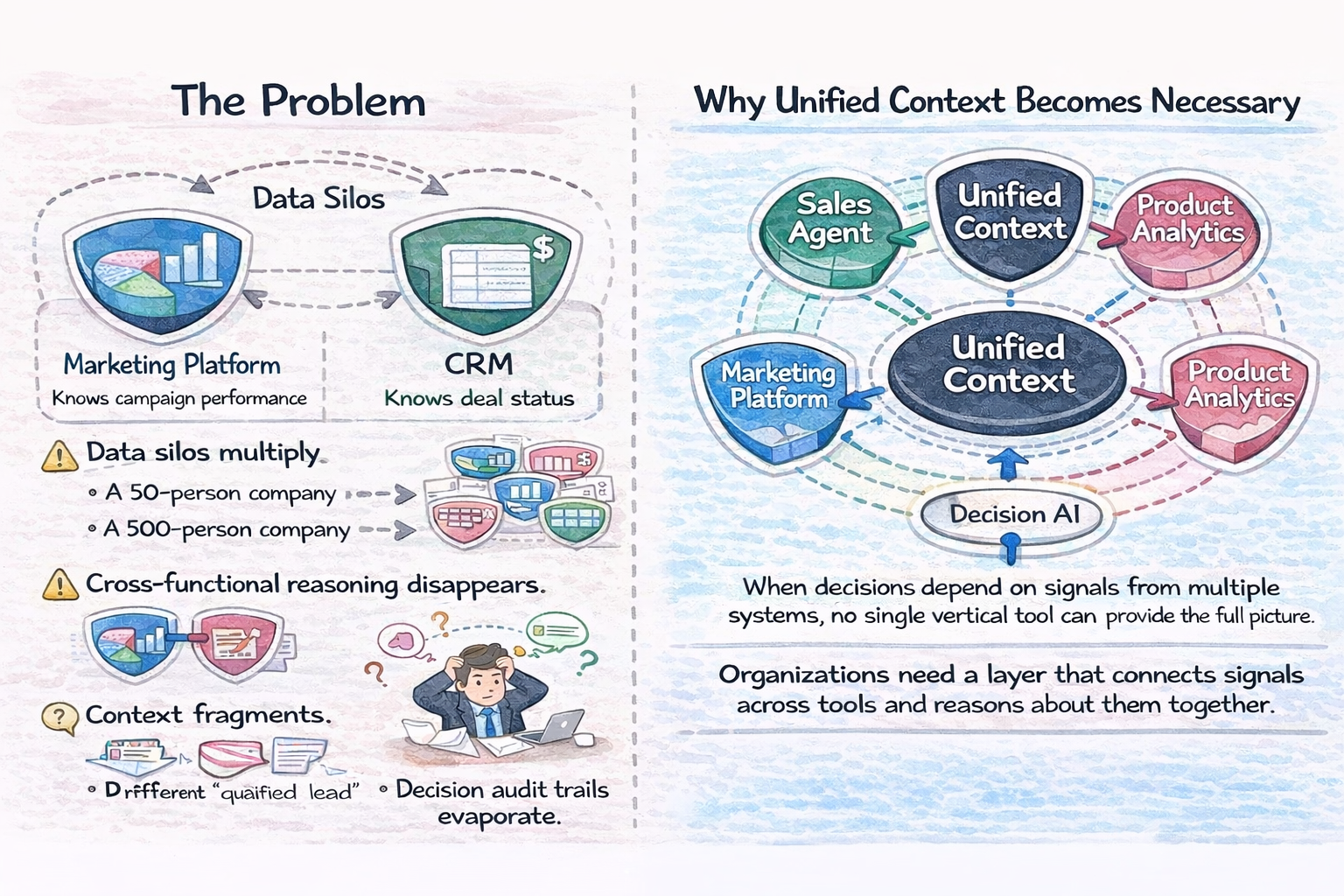
Each vertical tool sees its own slice. Your marketing platform knows campaign performance. Your CRM knows deal status. Your product analytics tool knows feature adoption. None of them reason across all three.
As organizations grow, the problem compounds:
Data silos multiply. A 50-person company might use 5 data tools. A 500-person company might use 50. Each tool has its own definitions, its own dashboards, and its own version of "pipeline."
Cross-functional reasoning disappears. The VP of Revenue ends up playing human middleware, manually stitching together signals from five different tools to make one decision. This takes days. By the time the analysis is done, the window for action may have closed.
Context fragments. When the marketing team's definition of "qualified lead" doesn't match the sales team's definition, every cross-functional decision starts with a reconciliation exercise instead of actual reasoning. This is the problem ontology solves.
Decision audit trails evaporate. When a decision depends on data from five tools, the reasoning behind it lives in someone's head, not in any system. Six months later, nobody can reconstruct why that pricing change was made or what assumptions it rested on.
When decisions depend on signals from multiple systems, no single vertical tool can provide the full picture. Organizations need a layer that connects signals across tools and reasons about them together.
This is the gap Decision AI fills. Not by replacing vertical tools, but by providing the reasoning layer that sits across them.
DecisionX connects to your existing tools and unifies their data into a single context layer. Green then reasons across all sources simultaneously, rather than requiring you to manually stitch spreadsheets and dashboards together. The 9-layer ontology ensures that "pipeline" means the same thing whether the signal comes from Salesforce, HubSpot, or a CSV export from your marketing platform.
DecisionX puts Decision AI into practice by continuously monitoring signals, structuring context, reasoning across hypotheses, and surfacing the next best action within a single system.


.png)
.png)