
Executive case study
Decision AI for Marketing Excellence
How a Top-10 Global Pharmaceutical Company leveraged a Self learning, Decision AI to gain an 11% Bottom line impact across their marketing spends in a complex multi geo, multi brand, multi channel landscape.
Emerging Markets50+ BrandsRx & OTC
The Customer
Top 10 Global Pharmaceutical Conglomerate
A top-10 global pharmaceutical company by revenue and brand portfolio, running a significant Emerging Markets commercial footprint: more than 50 brands, over 300 SKUs, multiple field forces, and a large HCP universe spread across several EM countries.
Roughly 6,000 field and commercial users now work on the platform, against more than two million HCP engagements. At that scale the arithmetic is unforgiving. A small improvement in how a rep decides where to spend the day compounds across thousands of reps and hundreds of thousands of interactions, and lands directly on top-line share and revenue. That is why sales intelligence sat here as a top-level priority rather than a field operations concern.
The Ground Reality
The Real World Complexity
The constraint was never ambition. It was the shape of the ground the ambition had to run on.
HCP targeting ran on static territory lists refreshed roughly once a year, in markets that move continuously. Commercial data sat in separate systems, CRM in one place, call logs in another, HCP databases and external signals elsewhere again, with no unified profile pulling them together. The knowledge that would have reconciled all of it, which HCPs actually matter and which reps need coaching, lived with field managers rather than in any system.
Measurement lagged in the same way. Root-cause on a margin or share miss meant an analyst manually stitching data across systems for days. Nothing surfaced leading indicators, so erosion only became visible after quarter-close, by which point the quarter was gone. Coaching leaned on activity counts rather than on the signals that actually predict prescribing outcomes.
Earlier AI attempts ran into a harder version of the same problem. A generic model hallucinates confidently when it has no business or compliance context. A margin dashboard can report that a number moved, but not which SKU or cost line moved it. And intelligence that restarts from scratch every cycle never compounds into anything.
The Decisioning Challenge
Sales Loop is Slow, Siloed and Broken
Put those conditions together and you get a decision loop that never closes inside the window it needs to.
Tracking was spread across multiple silos of dashboards, signal sources and interventions. Reps rarely updated their notes in Salesforce, so the signals that mattered sat somewhere else entirely: the CLM platform, the training app, the knowledge portal, the performance management system. Interventions, whether prioritisation, coaching or contextual content placement, arrived after the fact rather than as proactive signals. The recommendations that did arrive were generic, hard to act on, and never showed causality.
The sales excellence team spent a large share of its time simply stitching the loop together by hand: what changed, why it changed, what the next best action is. By the time an answer arrived the intervention window had usually closed. Blindspots compounded, at rep level and at cluster head level, and both the speed and the sharpness of what reps were told to do fed straight through to conversion, velocity and top line.
The Architecture
How the DecisionX platform works?
DecisionX autonomously connects Data, Domain and Process Context into a living Connected Enterprise Brain, continuously learning what changed, why it changed and the Next best action.
On the way in, the brain reads what the organisation already has. GBQ data covering sales, IQVIA, competitor activity, incentive plans, AOP and SAP. SFE and SAP records covering opportunity HCPs, historical records and call notes. CLM systems including Veeva, D360 and the dashboards that came before. And, critically, the tribal knowledge held by reps and cluster heads, which had never been anywhere a system could read it.
On the way out, decisions arrive in the flow of work rather than in a tool someone has to remember to open: AI reasoning, blindspots surfaced around the clock, tracking boards, and reports teams collaborate on directly. Every response carries an explainable, auditable trail, and the Ontology Studio stays fully governed by the Data and AI teams themselves, which is what makes the whole thing viable in a compliance-sensitive commercial function.
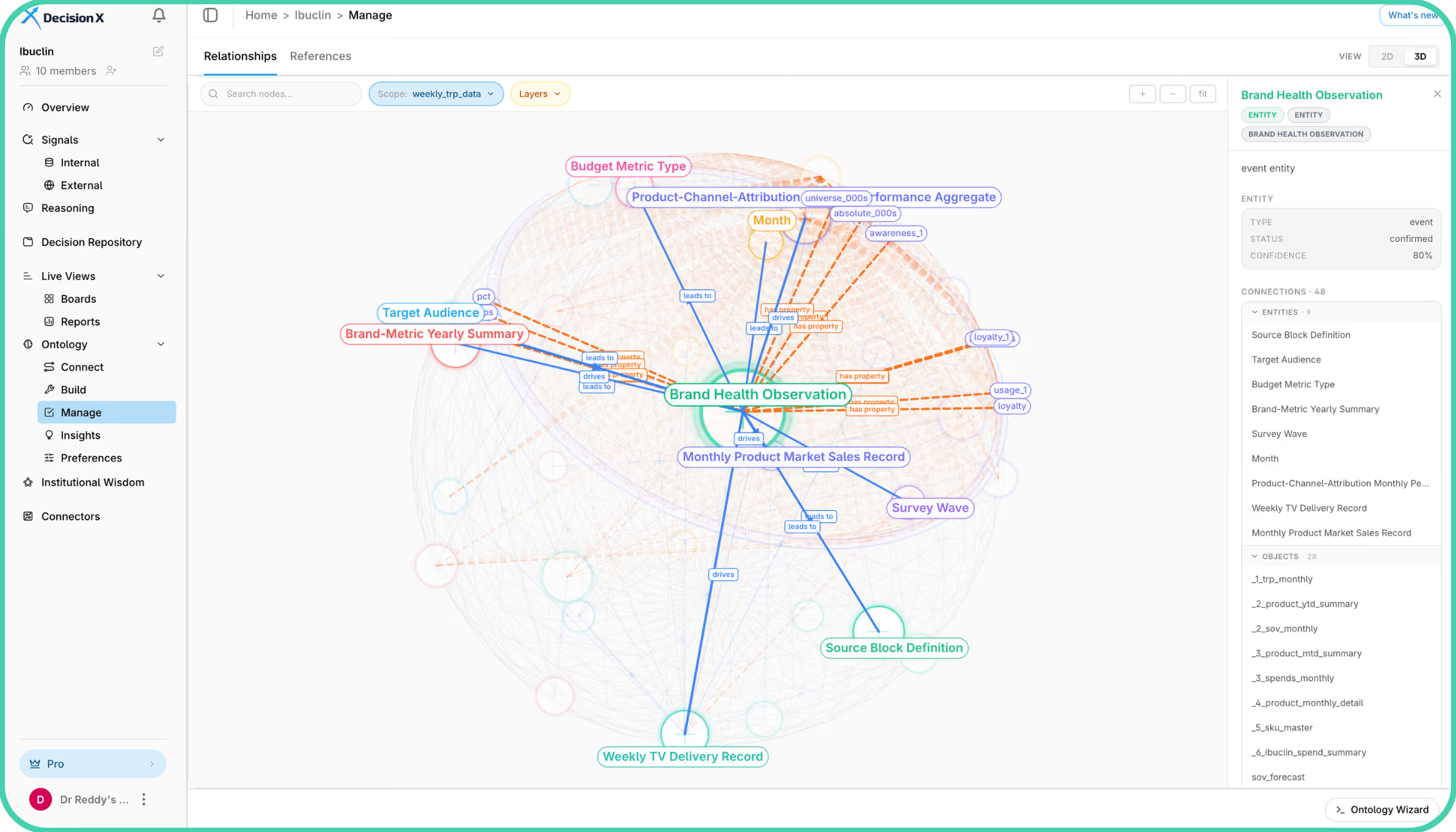
One unified ontology across domain, data and process, governed by the customer's own Data and AI teams.
The Operating Loop
The AI Native Tracking, Reasoning & Intervention
The platform runs one loop, continuously, and the value is in how quickly it closes.
It tracks around the clock and surfaces blindspots into mail and chat. It reasons over what it finds, establishing why something moved and what to do about it, then delivers automated signals to the excellence team: HCP opportunity prioritisation, sharper positioning and placement with competitive awareness, and in-the-moment sales coaching delivered in context.
Those recommendations land as interventions where the work already happens, in the mailbox, the field force app and WhatsApp. No dashboard to open, no context to stitch. Then the loop starts again, and what it learned this cycle is still there the next one.

The Outcome
Real Impact at Scale
The numbers below are production outcomes, not a pilot result.
For the sales organisation the effect showed up first as capacity. Pointed next best actions on opportunity prioritisation roughly doubled effective selling capacity, and the time to answer any business question, whether a root-cause analysis or a rep performance benchmark, came down to about 60 seconds from what had been a multi-day exercise. For the data team, an ontology build estimated at twelve months at this scale was compressed to 45 days, and what came out of it was one fully governed ontology rather than a point solution.
Bottom Line Impact
Trusted by
.avif)
.avif)
.avif)
.avif)
.avif)
.avif)
.avif)
.avif)