Decision Object: The Repository That Ensures Causality Is Never Lost - Step 3

Ranjan Kumar

June 16, 2026
Every important decision your organization makes today will be revisited, challenged, or built on again , by someone who wasn't in the room when it was made. The question is whether that person will have access to the reasoning that produced it, or whether they will be starting from zero. In most organizations, they start from zero. Every time.
Steps 1 and 2 of the Decision Lifecycle produce something valuable: a current picture of what is changing and a structured answer to what it means. Step 3 is the pivot point , the moment where that reasoning either gets captured in a form that persists and compounds, or disappears the moment the meeting ends.
A decision is not just a call. It is a call plus the context that made it the right call at the time: the signals that surfaced, the reasoning that ran, the assumptions made, the alternatives rejected, and the conditions under which the decision should be revisited. Capturing all of that , not just the outcome , is what "Decision as Object" means. Its output is a Reasoning Object: a persistent, searchable, retrievable record of the full decision. Without it, Step 4 (Track) and Step 5 (Learn & Compound) have nothing to track or learn from.
Here is a scenario that plays out in organizations of every size and industry. A leadership team makes a significant decision , to enter a new market, restructure a pricing tier, pause a product line, shift budget between segments. The discussion is thorough. The reasoning is sound. The right people were in the room.
Eighteen months later, a new VP joins. Or a board review asks why the decision was made. Or a similar decision needs to be made in an adjacent context. Or results diverge from the plan and someone needs to understand which original assumption was wrong.
What exists at that point? Usually: the outcome, captured in a P&L or a board deck. Occasionally: a slide that summarizes the decision. Almost never: the actual reasoning , why this path over the alternatives, what the team was uncertain about, what they assumed would hold.
Here is what gets lost in the gap between "the decision was made" and "the decision was documented as a full reasoning record":
What remains is the outcome. What disappears is the causality , the chain of reasoning that connected the situation to the commitment. And without causality, every future decision that builds on this one starts from a partial foundation.
The organizational cost of this pattern is significant. McKinsey and the Institute of Directors estimate that poor decision quality costs a typical Fortune 500 company $250 million annually , a substantial portion of which comes from decisions that were re-litigated, re-made, or made inconsistently because the original reasoning was not available.[1] Bain & Company found that executives estimate they lose 40% of a strategy's potential value not to bad planning but to execution breakdowns , many of which trace back to teams executing against a decision they did not fully understand because the reasoning was never captured.[2]
Definition
Decision as Object is the practice of capturing a strategic decision not just as an outcome but as a complete reasoning record , the logic, the assumptions, the alternatives considered, and the conditions under which it should be revisited , in a form that persists, is searchable, and can be retrieved by anyone who needs to understand, build on, or challenge it later.
Defined as Step 3 of the Decision Lifecycle by Ranjan Kumar, Founder of DecisionX, it is distinct from meeting notes (which capture what was said, not why), from project management records (which capture tasks and outcomes, not reasoning), and from financial models (which capture the arithmetic, not the judgment). A Decision as Object , also called a Reasoning Object , is the unit of institutional decision intelligence: it preserves the causality of the decision, making it possible to track assumptions against reality in Step 4 and extract learning in Step 5. Without it, the Decision Lifecycle is incomplete. With it, every decision an organization makes becomes part of a compounding body of institutional knowledge.
The simplest way to draw the line: a meeting note tells you what was decided. A Reasoning Object tells you why , and more importantly, it tells you what would have to change for the decision to be wrong. That is the information that makes future decisions smarter.
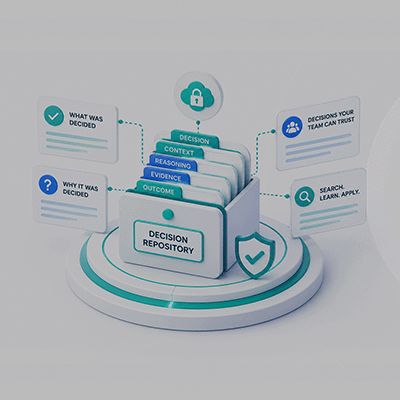
A Decision Repository is not a filing cabinet for decisions. It is a living, searchable body of institutional reasoning that changes how an organization learns, aligns, and builds on its own history. Three distinct capabilities emerge from having one.
The core capability is the simplest to describe but the least common in practice: at the moment a decision is made, the full reasoning record is captured , the call itself, the reasoning behind it, the three or four assumptions it rests on, the alternatives that were considered and rejected, and the specific conditions that would warrant revisiting it. This becomes the Reasoning Object.
The reason this matters beyond archival value is that it directly enables the next two steps in the lifecycle. Without a formally captured assumption set, there is nothing to track in Step 4. Without a captured record of alternatives rejected and why, there is nothing to learn from in Step 5 when the outcome diverges from the plan.
A single Reasoning Object is valuable. A searchable library of them , organized by decision type, business domain, time period, and outcome , is transformative. The Decision Repository is what turns individual captured decisions into compounding institutional intelligence.
The practical value surfaces most clearly at three moments: when a new leader joins and needs to understand why the organization is configured the way it is; when a similar decision arrives and the team wants to know what was tried before and what was learned; and when a decision underperforms and the post-mortem needs to trace back to the original assumption, not just measure the gap to plan.
Decisions travel. A pricing call made in the leadership meeting affects how Sales positions the product, how Finance models the quarter, how Customer Success manages renewals, and how Marketing frames the value proposition. In most organizations, the decision travels as a summary , a Slack message, a slide, an email , and the reasoning that justified it does not make the trip.
When a Reasoning Object is the artifact that travels, every downstream function receives not just the call but the context: why it was made, what it assumes, and what would change it. That context changes how each function executes , from executing a directive they do not fully understand to executing a commitment they can reason about and adapt to within its stated boundaries.
A Reasoning Object is not a long document. It is a structured record with six specific fields , each one there because it serves a distinct purpose in the lifecycle of the decision after it is made.
Here is the uncomfortable truth about most organizations: the reasoning behind their most important decisions is documented. It is just documented in places that are not connected, not searchable, and not structured in a way that makes the causality retrievable.
Here is where the real decision record lives in a typical organization today:
The actual debate happens here. "I think we should go with option B because of the Q2 churn data." "Agreed , and if we see enterprise dip below 80% retention we should revisit." This is genuine reasoning, in plain language, time-stamped.
"Our Q3 priority is enterprise expansion over mid-market because our win rate in enterprise improved 12 points following the product refresh, and mid-market CAC is unsustainable at current conversion rates." The reasoning for major strategic bets is often here , just not in a structured form.
The data that drove the decision lives here , pipeline data, revenue models, forecast spreadsheets. The assumptions were built from this data. The decision was justified by it.
Pre-meeting alignment, board presentations, post-meeting summaries. Often the most complete narrative account of why a decision was made , in someone's inbox, attached to a calendar invite, or in a notes doc that no one maintains.
The reasoning exists. It is just fragmented across systems that were never designed to hold it together, in formats that do not survive leadership changes, and without the structure that would make it retrievable when the next relevant decision arrives.
Most organizations that want to improve how they capture decisions approach it as a process problem: let's build a template, create a new Notion page, make it someone's responsibility to fill it in after every leadership meeting. These efforts fail consistently , not because the intent is wrong, but because they add friction to the moments when decisions are actually being made, and because they depend on a human to do the extraction work that the systems already contain the raw material for.
DecisionX approaches this differently. Instead of asking teams to document decisions after the fact, it extracts the decision record from where the reasoning already lives , and structures it into a Reasoning Object automatically.
DecisionX reads across the systems where decision reasoning naturally lives , Slack conversations, OKR documents, strategy memos, CRM and planning system data, meeting notes, and structured and unstructured data sources , and extracts the decision record from each. It identifies what was decided, what reasoning was expressed, what assumptions were implicit in the language used, and what conditions were stated or implied for revisiting the call.
This extracted record is then structured into a Decision Ontology: a living, interconnected map of the organization's strategic decisions, their causality, their assumptions, and their relationships to each other. It is not a database of decisions. It is a knowledge graph , where pulling on one decision surfaces the reasoning that connects it to the decisions that came before and the ones that came after.
The result is a Decision Repository that requires no additional documentation burden from the team. The work they are already doing , the Slack discussions, the OKR writing, the board prep , becomes the source material. DecisionX structures it, connects it, and makes it retrievable.
What this produces is something no organization has had before: a searchable, connected record of not just what decisions were made, but why , with the causal chain intact. A new VP of Sales can ask "why did we deprioritize mid-market in 2024?" and receive not a summary slide but the actual reasoning: the signals that surfaced in Step 1, the analysis from Step 2, the assumptions the decision rested on, and the conditions under which it was expected to be revisited. The causality is preserved. The institutional memory is available.
A new Chief Revenue Officer joins 14 months after a significant pricing restructure. She needs to understand why the current pricing architecture exists and whether the assumptions that justified it still hold.
She schedules meetings with three people who were in the room. Two give her different accounts of the primary rationale. One has left the company. The original slide deck exists but it shows the outcome model, not the reasoning. The Slack thread where the actual debate happened is 14 months buried. She forms a working hypothesis, re-runs similar analysis, and arrives at a conclusion that partially duplicates work already done , and misses two assumptions that were explicitly discussed but never recorded. Six months into her tenure, she adjusts the pricing strategy based on an incomplete picture of why it was set the way it was. Two of her changes inadvertently reverse decisions that had been made deliberately.
She queries the Decision Repository. The Reasoning Object for the pricing restructure surfaces in seconds: the competitive signals that prompted it, the analysis of churn elasticity at three price points, the three assumptions the decision rested on (enterprise retention above 88%, NPS stable through the transition, competitive pricing unchanged in the mid-market), the alternatives rejected, and the revisit trigger (if enterprise retention drops below 85% for two consecutive quarters, pricing strategy is reviewed). She can see that one of the three assumptions , competitive pricing in mid-market , has shifted. The repository flags it. She enters her first pricing conversation already knowing what has held, what has changed, and where the decision was designed to flex. She builds on it rather than unknowingly undoing it.
Step 3 is the pivot between the pre-decision and post-decision halves of the lifecycle. Steps 1 and 2 produce reasoning. Step 3 captures it. Steps 4 and 5 only work if Step 3 has done its job , because you cannot track an assumption that was never formally named, and you cannot learn from a decision whose reasoning was never recorded.
↑ Step 5 learning feeds back into Step 3 , each new decision is captured with better-calibrated assumptions drawn from the patterns in past Reasoning Objects.
There is also a compounding effect specific to the repository. The more decisions that are captured as Reasoning Objects, the more useful the repository becomes , because patterns emerge. Assumptions that were consistently wrong. Decision types that consistently outperformed their forecasts. Contexts in which certain alternatives were consistently rejected for the same reasons. This is institutional intelligence that no individual carries and that no departure can take away.
About this series
The Decision Lifecycle Feature Series maps the five steps that connect a strategic signal to institutional learning. Developed by Ranjan Kumar at DecisionX.
Step 1 , Signals & Blindspot Monitoring · Step 2 , Reasoning · Step 3 , Decision as Object (this article) · Step 4 , Track · Step 5 , Learn & Compound
Companion reading: the Decision Made ≠ Decision Done industry series , where the post-decision gap costs CPG, Manufacturing, Pharma, India D2C.

Ranjan Kumar is the Founder and CEO of DecisionX AI, the world’s first self-learning, context-aware Decision Intelligence platform that enables enterprises to make smarter, faster business decisions through agentic AI. A serial entrepreneur and three-time founder with over 17 years of experience, Ranjan previously built Entropik, the world’s first Emotion AI platform with 17 global patent claims. An IIT Kharagpur alumnus, he is widely recognized as a thought leader in enterprise AI, Ontology Engineering, decision reasoning, and AI-driven business transformation.