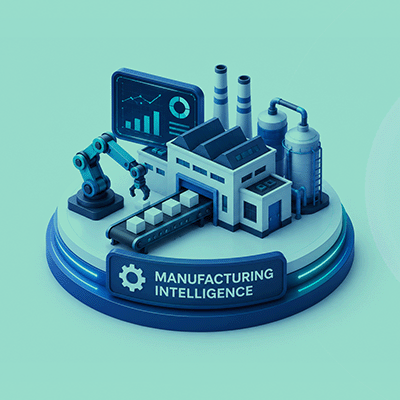
No industry runs with more operational discipline than manufacturing. The data infrastructure is real, the governance is rigorous, and the execution culture is second to none. The challenge lives one level up, in translating all of that intelligence into strategic decisions that hold over a three-to-seven-year horizon.
When we look at manufacturing through the Decision Lifecycle lens, Pre-Decision, Decision, Post-Decision, something interesting emerges. The industry doesn't have a single, obvious failure point the way other sectors do. It has three distinct challenges, each at a different stage, each genuinely hard for structural reasons that have nothing to do with capability gaps. Understanding where each challenge sits, and why it's hard, is the starting point for building better.
What is the Decision Lifecycle?
The Decision Lifecycle is the end-to-end process through which a strategic decision moves from signal to institutional learning. First defined and applied to enterprise strategy by Ranjan Kumar at DecisionX, it comprises three stages: Pre-Decision, sensing signals, assembling context, and reasoning before commitment; Decision, making the call and capturing the reasoning as a persistent object; and Post-Decision, tracking assumptions, running root cause analysis, and converting outcomes into compounding institutional knowledge. In manufacturing, all three stages carry genuine complexity. The challenge is not that manufacturers make bad decisions, it's that the infrastructure to support the full lifecycle hasn't kept pace with the scale and irreversibility of the decisions being made.
Below is how manufacturing scores across all three stages, based on research from McKinsey, Deloitte, Manufacturing Dive, and Eclipse Automation. These scores reflect structural patterns across the industry, not any single organisation. The intent is to map where the genuine complexity sits, not to critique. Click any stage to explore the detail.
Manufacturing's Pre-Decision environment is genuinely impressive. ERP systems. MES platforms. OEE dashboards updated in near real-time. Supply chain visibility tools monitoring Tier-1 and Tier-2 suppliers. PMI and macro demand indicators feeding the planning function. On raw data availability, no industry does it better.
The challenge is what happens next. Having data and being able to reason across it are two different capabilities, and in manufacturing, the gap between them is significant.
When we look closely at how pre-decision work actually happens before a major CapEx commitment, three distinct challenges emerge. Each is worth understanding on its own terms.
The data is organised around functions, not decisions. Finance sees the model. Operations sees the line. Procurement sees the supplier map. No single actor has a unified picture assembled around the specific decision being made.
The IRR model becomes the proxy for reasoning, but IRR is arithmetic on assumptions, not reasoning itself. The cross-dimensional question, "should we reshore Line 4 given tariff scenario X and demand scenario Y?", rarely gets answered before the board paper is written.
Budget cycles are fixed. What should be a six-month reasoning process compresses into four weeks before board submission. Stress-testing and scenario modelling get shortened into financial packaging under deadline pressure.
The consequence of all three is that manufacturing enters its most consequential decisions, plant expansions, automation programmes, reshoring moves, with strong functional views and a weak unified picture. As Manufacturing Dive notes, two in three manufacturers plan to increase equipment investments in 2026 with median planned spending up 34% from 2024,[2] but what's missing is a clear process for deciding where the money goes when every direction feels both necessary and risky.[3]
Any given quarter, the strategy function in a major manufacturer is working through some version of these. Each one requires reasoning across at least three data sources simultaneously, and the answer to each changes meaningfully depending on how the others resolve:
These questions are interdependent. The reshoring answer changes the utilisation answer. The workforce answer changes the automation answer. Reasoning about them in sequence, as most pre-decision processes do, produces a different outcome than reasoning about them together. Deloitte's 2026 Manufacturing Industry Outlook found that the top concern for more than a third of 600 manufacturing executives was equipping workers with the skills to maximise smart manufacturing investments[4], which is precisely the kind of second-order consequence that gets missed when questions are reasoned about in isolation rather than as a system.
This is the stage that most decision frameworks skip over, and it's where some of manufacturing's most significant value leaks. The Decision stage in the lifecycle isn't just about making the call. It's about the quality of translation from fragmented functional inputs to a coherent strategic commitment.
In practice, manufacturing's decision-making governance is genuinely strong. Investment committees, staged approval gates, IRR thresholds, board-level review. The process is rigorous. The challenge is not the process, it's what the process is designed to evaluate.
What a CapEx approval process evaluates is: does the financial model clear the hurdle rate? What it rarely evaluates is: are the assumptions underlying the financial model the product of synthesised cross-functional reasoning, or are they the product of whichever function's view was most persuasive, or most conveniently timed to the budget cycle?
The result is a specific and important dynamic. A $100M production line gets approved not because the reasoning was comprehensively stress-tested, but because the IRR cleared the threshold. The supply chain team raised a concern about workforce ramp-up in a pre-board meeting. It was noted. It was not formally weighed against the IRR. The decision was made, on the basis of financial arithmetic rather than synthesised reasoning.
Eclipse Automation, which works closely with manufacturers on large automation programmes, observed this directly: "Most automation programs fail because requirements are not defined properly on both sides. That creates variation in expectations and leads to costly assumptions before capital is even approved."[5]
There is a second problem at this stage worth naming clearly: the Reasoning Object, the captured logic of the decision, including the assumptions it rests on, the alternatives considered, and the conditions under which the decision would be revisited, is almost never created. The board paper exists. The financial model exists. But neither of these is a Reasoning Object. Neither can be interrogated against what actually happens. Neither survives leadership transition in a usable form.
The most consequential and most common high-stakes decision in manufacturing: committing $50-200M to a new production line or facility expansion based on a 3-year demand forecast. The business case is built with genuine care, demand projections are modelled, IRR and payback period are calculated, best and worst case scenarios are run.
Three assumptions are embedded in every version of this business case. They are almost never made explicit as trackable commitments at the point of approval:
Demand will hold at the volume and margin levels modelled at approval for the duration of the payback period.
The tariff and trade policy environment will remain stable through the payback period, the unit economics that justified the investment won't be eroded by policy shift.
The workforce and skills base required to operate the new line will be available at the planned ramp-up timeline.
The reason these aren't tracked is not negligence, it's architecture. The variance report, which is well-run and genuinely valuable, is designed to measure execution against commitment. It was never designed to measure the continuing validity of the assumptions underneath the commitment. These are different questions, and building the infrastructure to track both is the practical opportunity this stage presents. Only 36% of manufacturers are actively revisiting CapEx commitments in response to tariff shifts[6], which suggests that even when the external assumption has demonstrably changed, the mechanism to trigger a formal assumption review is often absent.
This is where manufacturing's profile diverges most sharply from other industries in this series. In CPG, post-decision tracking is largely absent. In manufacturing, it is mature, disciplined, and well-resourced. Variance analysis is run quarterly. The CFO reviews it. Operations teams own the gap.
The challenge is not the absence of tracking. It is a more specific and solvable one: the variance report tracks actual versus plan on revenue and cost, but not whether the three assumptions that made the plan valid are still holding. These are different questions, and the gap between them has real consequences.
When a production line runs below forecast, a well-run variance report will surface the gap clearly. What it cannot tell you, because it was not designed to, is whether the gap is primarily an execution problem or a strategic assumption failure. Was the demand forecast too optimistic? Did tariffs shift the unit economics in year two? Did the workforce ramp take six months longer than planned, long enough to miss the market window?
These are three completely different diagnoses requiring three completely different responses. Without assumption tracking alongside plan tracking, they look identical in the P&L. As Wiss, which works closely with manufacturing finance teams, observes: conflating a volume variance with a cost control problem is a common analytical error, the right management conversation changes entirely depending on which assumption failed.[7]
Manufacturing already has the cadence, quarterly variance review, operational dashboards, CFO-level scrutiny. The enhancement is relatively contained: add three rows to the existing review. For each major CapEx commitment currently being tracked, the quarterly review should ask not just "how is actual vs plan?" but "how is each of the three original assumptions holding?" Demand still at modelled volume? Trade policy still stable? Workforce ramp on schedule? Each question takes minutes to answer. The aggregate answer, reviewed quarterly, creates a feedback loop that makes the next business case meaningfully smarter.
The irreversibility of manufacturing CapEx makes this enhancement particularly valuable. A machine purchased for €500,000 is on the balance sheet for 7-12 years.[8] The earlier an assumption failure is detected, the more options remain available, renegotiating supplier contracts, adjusting production mix, accelerating or deferring adjacent investments. Catching a deteriorating assumption in quarter four of year one looks completely different from catching it in year three when the P&L miss is already undeniable.
Looking across all three stages together, the picture that emerges is not one of systemic failure, it is one of a structurally strong operational intelligence that hasn't yet been fully connected to the strategic decision process that governs the investments it's measuring.
Manufacturing organisations already have most of what they need. The data infrastructure for Pre-Decision is there. The governance for the Decision stage is there. The review cadence for Post-Decision is there. What's missing is the connective tissue: a unified context layer that assembles data around decisions rather than functions at the Pre-Decision stage; a Reasoning Object that captures the assumptions at the moment of approval; and an assumption-tracking mechanism that sits alongside, not replacing, the existing variance report.
The operational intelligence exists. The governance exists. The review cadence exists. What the full Decision Lifecycle adds is the architecture that connects them, so that the $100M decision made in the boardroom is as well-supported as the line it funds on the factory floor.
The manufacturers building this connective tissue are finding that the same decision, a CapEx commitment, a reshoring move, an automation programme, becomes a compounding asset rather than a one-time event. Each cycle, the assumptions from the last decision feed the reasoning for the next. The business case gets smarter. The board paper gets sharper. And when something doesn't go to plan, the organisation knows which lever to pull, because it knows which assumption moved.
About this series
Decision Made ≠ Decision Done applies the Decision Lifecycle framework, developed by Ranjan Kumar at DecisionX, to the strategic decisions that define each industry. Each article maps where the genuine complexity sits across Pre-Decision, Decision, and Post-Decision stages, and what building better looks like in each.
Introduction · Article 1, D2C · Article 2, CPG · Article 3, Manufacturing (this article) · Article 4, Pharma (coming)


Ranjan Kumar is the Founder and CEO of DecisionX AI, the world’s first self-learning, context-aware Decision Intelligence platform that enables enterprises to make smarter, faster business decisions through agentic AI. A serial entrepreneur and three-time founder with over 17 years of experience, Ranjan previously built Entropik, the world’s first Emotion AI platform with 17 global patent claims. An IIT Kharagpur alumnus, he is widely recognized as a thought leader in enterprise AI, Ontology Engineering, decision reasoning, and AI-driven business transformation.