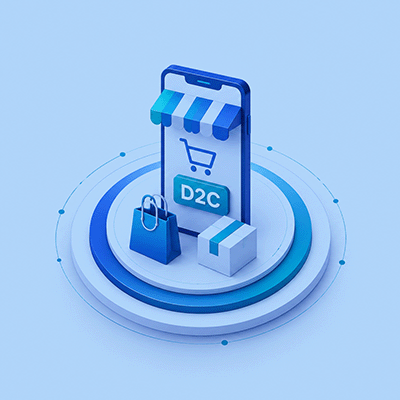
India's D2C ecosystem is the world's second-most funded, home to over 800 active brands and 250 million online shoppers. The founders building in this space are among the most market-aware operators in the world. The challenge is not their instinct. It is the infrastructure to convert that instinct into decisions that hold, scale, and teach the next decision something.
When we look at Indian D2C through the Decision Lifecycle lens, the profile that emerges is genuinely distinct from the CPG or manufacturing stories. This is not an industry with weak data infrastructure or absent governance. It is an industry where the pace of the market and the pace of the decision process are fundamentally misaligned, and where the signals that founders are excellent at reading rarely get converted into reasoned, trackable strategic commitments.
India adds layers that do not exist in Western D2C markets. A consumer base that behaves differently across Tier 1, Tier 2, and Tier 3 cities. A channel landscape that shifted three times in five years, from direct website to marketplace-first to quick commerce to omnichannel to whatever comes next. A funding environment that rewarded growth speed in 2021-22 and rewarded unit economics discipline in 2024-25. And a CAC environment where Meta CPMs rose 20-25% year-on-year[1] while over 70% of brands remained dependent on a single acquisition channel.[2]
Navigating all of that requires a different quality of decision-making. Not just faster decisions, but decisions with better-articulated assumptions, tracked against what actually happens.
What is the Decision Lifecycle?
The Decision Lifecycle is the end-to-end process through which a strategic decision moves from signal to institutional learning. First defined and applied to brand strategy by Ranjan Kumar at DecisionX, it comprises three stages: Pre-Decision, sensing signals, assembling context, and reasoning before commitment; Decision, making the call and capturing the reasoning as a persistent object; and Post-Decision, tracking assumptions, running root cause analysis, and converting outcomes into compounding learning. In India D2C, the speed of the market creates particular pressure on all three stages, in ways that are worth understanding specifically.
Below is how India D2C scores across all three lifecycle stages, based on research from DSG Consumer Partners, Redseer Strategy Consultants, KPMG India, Tracxn, and FireAI. The scores reflect structural patterns across founder-led D2C businesses in India, not any individual brand. The intent is to understand where the complexity genuinely lives. Click any stage to explore.
India's D2C founders are, as a group, exceptional market sensors. Consumer intuition is sharp. Category knowledge is deep. Trend identification, particularly in beauty, food, personal care, and fashion, is often genuinely ahead of the data. This is a real and significant advantage. The Pre-Decision score of 61/100 reflects it.
The challenge is the next step: converting that sensing into a structured context that can support a consequential strategic commitment. And this is where three specific gaps appear consistently.
Performance data lives in Meta Ads Manager. Retention patterns live in WhatsApp flows and Shopify cohorts. Offline signals live in the founder's head. Quick commerce data lives in Blinkit or Zepto dashboards. No single view exists when a channel or geography decision needs to be made.
Lower CPMs in Tier 2/3 cities look attractive until the conversion architecture, language, trust signals, product education, COD dependency, is built for that market. Brands enter because CACs look cheaper, then run metro creative into Tier 2 and wonder why conversion does not follow.[4]
Quick commerce went from experiment to primary growth engine for many FMCG and D2C brands in under three years.[5] Each channel shift resets the unit economics and the competitive positioning assumptions. Pre-decision reasoning has to work at the speed of the channel, and often does not.
The consequence of these three gaps is that major decisions, channel mix shifts, city expansion, pricing architecture, offline rollout, are often made on a strong instinctive read without the structured context assembly that would make the reasoning explicit and the assumptions trackable. As one analysis of 35 Indian D2C brands noted: the strongest predictor of outcome is not any single metric but the combination of repeat purchase rate, channel mix diversification, and CAC payback, and these interact in ways that surface only when reasoned together, not independently.[6]
These are the questions that define the hardest calls for a scaling Indian D2C brand. Each one requires reasoning across at least three data sources, and the answer to each changes how the others should be approached:
These are not questions most founders are unaware of. They are questions that are actively discussed in every board meeting and founder WhatsApp group in the ecosystem. The challenge is that the reasoning that leads to an answer, and the assumptions embedded in that reasoning, rarely gets written down as a structured commitment before the decision is made. And when the channel or the city performs differently from expectation, there is nothing explicit to interrogate.
This is the stage where India D2C's specific context creates the most friction, and it scores the lowest of the three at 38/100, for reasons that are structural rather than a reflection of founder capability.
Indian D2C decision-making operates in a high-velocity environment where the cost of waiting for a complete picture is real. A quick commerce partnership window opens and closes in weeks. A performance marketing window with strong ROAS has to be capitalised on before the auction moves. An offline retail opportunity in a specific geography requires a commitment before a competitor takes the shelf. In this environment, the instinct to move fast is not a flaw. It is often the right response to a genuine market dynamic.
The challenge is the translation gap: the move from "this feels right, the signals are pointing this way" to "here are the three assumptions this decision rests on, here is the condition under which we would revisit it, here is what we are explicitly betting." That translation step, which turns an instinct into a Reasoning Object, is what most fast-moving D2C decisions skip.
The consequences are specific and observable. When a channel bet does not hold, when the quick commerce allocation that looked attractive at a certain contribution margin becomes margin-dilutive at scale, the post-decision review asks "what happened to our numbers?" rather than "which assumption about the channel's contribution margin at scale was wrong?" These are different questions, and only the second one teaches the next decision anything.
Research on why Indian D2C brands struggle to cross the Rs 100 crore mark is consistent: rising CAC, creative fatigue, and weak retention are the three symptoms most cited, but all three are expressions of the same underlying issue: a channel mix decision that was made without explicit assumptions about how the unit economics would hold as the brand scaled.[2] The decision was made. The assumptions inside it were never named.
The most consequential and most common strategic decision in India D2C: where to allocate the growth budget across channels, Meta performance, Google, influencer, quick commerce, marketplace, owned D2C, and offline, and how to hold that allocation as the brand scales.
This decision gets made constantly, often implicitly, and almost never as a formal commitment with named assumptions. Three assumptions are embedded in every version of this decision:
CAC on the primary acquisition channel will remain within the payback envelope as spend scales. The blended CAC will not exceed 12-month payback at 2-3x current budgets.
The channel driving discovery is also building brand equity and repeat, not just first-purchase conversion that relies on perpetual acquisition spend to sustain revenue.
The consumer behaviour and category dynamics that make this channel mix work today will remain stable for the 12-18 month investment horizon the decision implies.
The LTV:CAC ratio most D2C investors expect is 3:1 or higher for a sustainable model. Many Indian brands operate at 1.5-2.5x.[7] The gap between 1.5x and 3x is not usually a CAC problem in isolation. It is a retention assumption that was implicit in the channel decision and never tracked. The brand committed to a channel that was excellent at acquisition and structurally weak at building the repeat purchase rate that would have made the economics hold. Without the assumption named at the point of commitment, there is nothing to track and nothing to learn from when the gap surfaces.
India D2C scores 22/100 at the Post-Decision stage, higher than manufacturing's 9/100, because the metric tracking culture in D2C is genuinely stronger than in most industries. CAC, ROAS, LTV, retention cohorts, contribution margin, these are tracked weekly or daily by most scaling brands, and the data quality is often good.
The gap is between tracking metrics and learning from decisions. These are related but not the same thing. Tracking metrics tells you what happened. Learning from a decision tells you why, specifically, which assumption you made when you committed to the channel, the city, or the SKU turned out to be wrong, and in what direction. Only the second version makes the next decision smarter.
The pattern in India D2C post-decision reviews, board decks, investor updates, internal retrospectives, is that they are outcome-focused. Revenue against target. CAC against last quarter. ROAS against benchmark. These are the right things to measure. What they do not contain is: "the assumption we made when we committed to this channel was X, here is how X actually held."
The most expensive version of the Post-Decision gap in India D2C is channel decisions that get made, underperform, and are revised, but without identifying which assumption failed. The next channel allocation inherits the same structural blind spot. A brand that over-indexed on Meta, saw CAC inflate as it scaled, pulled back, and shifted budget to influencer without understanding whether the core issue was channel dependency, creative fatigue, or a retention model that required perpetual acquisition spend, will encounter the same economics issue in the new channel within 18 months. The problem was not Meta. The problem was an assumption about how repeat purchase behaviour would develop that was never made explicit and never tested.
The 60-65% of Indian D2C brands stuck below Rs 50 crore in revenue[3] are not generally stuck because of weak execution or bad product. They are stuck because each growth decision they make, a new channel, a new city, a new SKU, is made without the learning from the last one. Not because the data does not exist, but because the decision review process extracts outcomes rather than assumption insights. The next decision starts nearly from scratch.
The brands that have crossed Rs 100 crore, Country Delight, HealthKart, Mamaearth, Boat, Noise, Licious, share a common structural feature: they built a repeatable decision logic around their core unit economics. Not just metrics tracking, but an understanding of which assumptions about consumer behaviour their model depends on, and a discipline of watching those assumptions rather than just watching the P&L.
The India D2C context is unique in this series because the challenge is not one of data, capability, or governance. It is one of pace. The market moves fast enough that slowing down to structure a decision feels like a competitive disadvantage. In some cases, it genuinely is.
But the brands that are compounding, that make a channel work, understand why it worked, carry that learning into the next channel decision, and build a model that improves with each cycle, are not moving slowly. They are moving with structured instinct. They have strong market read and the habit of making the assumptions inside their decisions explicit enough to track.
The sensing is world-class. The instinct is real. The market opportunity is generational. What the next stage of compounding growth requires is the infrastructure to convert instinct into assumption-bearing commitments, so that every channel decision, every city expansion, every CAC bet teaches the next one something. That is what makes a decision done, not just made.
About this series
Decision Made, Decision Done applies the Decision Lifecycle framework, developed by Ranjan Kumar at DecisionX, to the strategic decisions that define each industry. Each article maps where the genuine complexity sits across Pre-Decision, Decision, and Post-Decision stages, and what building better looks like in each.
Introduction · Article 1, India D2C (this article) · Article 2, CPG · Article 3, Manufacturing · Article 4, Pharma (Coming)


Ranjan Kumar is the Founder and CEO of DecisionX AI, the world’s first self-learning, context-aware Decision Intelligence platform that enables enterprises to make smarter, faster business decisions through agentic AI. A serial entrepreneur and three-time founder with over 17 years of experience, Ranjan previously built Entropik, the world’s first Emotion AI platform with 17 global patent claims. An IIT Kharagpur alumnus, he is widely recognized as a thought leader in enterprise AI, Ontology Engineering, decision reasoning, and AI-driven business transformation.