Knowing what is happening is not the same as knowing what to do about it. Step 1 surfaces the signals. Step 2 is where the real work begins , making sense of those signals, understanding what caused them, projecting where they lead, and finding the best path forward. This is reasoning. And in most organizations, it is the most expensive, slowest, and most fragile part of the entire decision process.
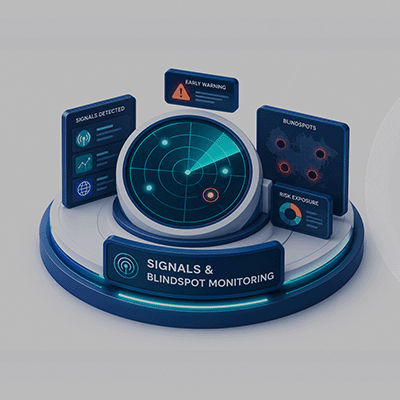
Step 1 , Signals & Blindspot Monitoring , produces a live, prioritized picture of what is changing across the business and the market. Reasoning is what turns that picture into an answer. It is the step that asks: why is this happening, what happens next under different scenarios, and what is the best move?
Without Reasoning, a signal is just a notification. The fulfillment constraint is flagged , but nobody knows whether it will affect three deals or thirty, whether the constraint is temporary or structural, or whether the right response is to expedite inventory, renegotiate a commitment, or reprioritize the sales pipeline. Reasoning is what produces those answers. Its output , a structured view with drivers, trade-offs, and a traceable path , is what Step 3, Decision as Object, captures and persists.
Here is a scene that plays out in almost every strategy function, every quarter. A question lands in the leadership meeting that cannot be answered from the materials in the room:
"If enterprise revenue misses Q3 by 15%, what does our Q4 look like , and which segment should we double down on to recover?"
It is a reasonable question. Every leadership team asks some version of it every quarter. And in most organizations, answering it means pulling an analyst off whatever they are doing, requesting a model update from Finance, waiting for Sales to send a cleaned pipeline export, and assembling the answer across three days of back-and-forth. By the time the answer arrives, the decision window has closed , or the decision has already been made on instinct.
This is not a competence problem. The analysts are capable. The data exists. The issue is structural: reasoning is locked behind human bandwidth. Every strategic question is a queue position. The questions that get answered quickly are not necessarily the most important ones , they are the ones with the most available analysts, or the ones asked by the most senior person in the room.
Here is what that looks like across a typical strategy team's question load:
| The question | What it requires | Typical wait |
|---|---|---|
| Why did gross margin drop 3pts in the South region last quarter? Root cause analysis across sales mix, COGS, and discounting data |
Analyst pulls and joins three data sources, segments by product and channel, eliminates confounding factors | 2-3 days |
| If we shift 20% of our marketing budget from performance to brand, what happens to CAC and 12-month LTV? Forecasting model with scenario branches |
Finance builds a model. Marketing validates assumptions. Two rounds of revision before leadership sees it. | 3-5 days |
| Which pricing tier gives us the best revenue outcome without exceeding 8% churn? Optimization across price elasticity, churn curve, and segment mix |
Data science team runs sensitivity analysis. Output is a model, not a recommendation. | 1-2 weeks |
| What happens to our Q3 plan if we lose our second-largest enterprise account? Stress test across revenue, pipeline, and cost base |
Finance runs a scenario. Often this does not get asked formally , it gets answered by gut feel in the room. | Asked, rarely answered |
McKinsey's research found that 68% of middle managers and 57% of C-level executives say most of their decision-making time is inefficient , and a primary driver is the time between when a question needs answering and when an answer arrives.[1] West Monroe found that this delay costs organizations up to 5% of annual turnover in decisions that arrive too late or on incomplete analysis.[2] The cost is not the analyst time. It is the decisions made without the answer in the room.
Definition
Reasoning is the process of translating a live picture of what is changing into structured answers , understanding why something happened, what happens next under different conditions, and what the best available path forward is.
Defined as Step 2 of the Decision Lifecycle by Ranjan Kumar, Founder of DecisionX, Reasoning is distinct from reporting (which describes what happened), from search (which retrieves information), and from dashboards (which display current state). Reasoning produces something none of these do: a structured answer with a traceable path , drivers identified, trade-offs surfaced, scenarios tested. Its output feeds directly into Step 3, Decision as Object, where the reasoning and its assumptions are captured as a persistent record. Without Reasoning, a decision is made on the basis of whoever had the best intuition in the room. With it, a decision is made on the basis of structured analysis of what is actually happening and what the alternatives produce.
The clearest way to draw the line: a report tells you that gross margin dropped 3 points last quarter. Reasoning tells you why it dropped , which product mix shift drove it, whether that shift is structural or temporary, and what the margin looks like across three different pricing responses. A report is a description. Reasoning is an answer.
Strategic questions are not all the same kind of question. Some ask why something happened. Some ask what will happen next. Some ask what the best option is. Some ask what happens if the plan breaks. These require different reasoning modes , and a complete Reasoning capability covers all four.
Most reporting tells you what changed. Root cause analysis tells you why , tracing a business outcome back through the chain of factors that produced it, separating the structural drivers from the coincidental ones, and identifying which lever actually needs to move.
Without RCA, strategy teams spend their time treating symptoms. With it, they treat causes , which means the fix holds and the same problem does not resurface in the next quarter with a slightly different shape.
Forecasting answers: if current trends continue, where do we land? What-if analysis answers: if we change this variable , spend, price, headcount, channel mix , what does the outcome look like? Together, they give leadership the forward view that turns a gut-feel decision into a calibrated one.
The gap in most organizations is not that forecasting does not happen , it does, in Finance, in quarterly models. The gap is that it happens on a schedule, not on demand. When a question arises in a Tuesday meeting, the forecast that exists is the one built for the last board pack, not the one that reflects this week's pipeline update, last month's churn, and this morning's competitive announcement.
Optimization answers a specific and practical question: given the constraints we are operating under , budget, headcount, margin floor, growth target , what allocation or configuration produces the best outcome? This is the reasoning mode that turns a resource allocation decision from a negotiation between functions into an analytically-grounded recommendation.
In practice, optimization questions are often the ones that never get answered formally , because building an optimization model from scratch takes a week, and the meeting happens tomorrow. So the allocation gets decided by seniority, by the loudest voice, or by last year's split with an incremental adjustment. The outcome is rarely optimal for the business.
Most strategic plans are built on base-case assumptions. Stress testing asks: what happens to this plan if one of those assumptions breaks? If the key account churns, if the new product launch is delayed by two quarters, if raw material costs rise 20%, if the regulatory environment shifts , does the plan still hold, and if not, where does it break first?
This is arguably the most valuable reasoning mode in a volatile environment , and the one most consistently skipped, because it requires someone to deliberately build a negative scenario and run it through the model. Most organizations find out where their plan breaks when the real event happens, not before it.
Here is one question , the kind that arrives in every leadership meeting , played out with and without Reasoning infrastructure in place.
The question: "We are 11% behind on enterprise revenue at the halfway point of Q3. Do we push harder on the existing pipeline, or should we shift budget toward a mid-market push to make up the gap?"
The question goes to the analyst team. Finance needs to update the revenue model. Sales needs to rescore the pipeline. Someone needs to pull the mid-market CAC data and model what a budget shift would produce. Three days later, a deck arrives. By then, the leadership team has already decided , informally, based on the strongest opinion in the room , to push harder on enterprise. The deck confirms that mid-market was probably the better call. The quarter ends 9% below target.
The question is run in the meeting. RCA surfaces that 70% of the enterprise shortfall is concentrated in three stalled deals with known blockers , not a pipeline volume problem. Forecasting models both paths: pushing enterprise closes the gap only if two of the three deals convert by week 10. Shifting budget to mid-market produces a more predictable but smaller recovery. Optimization runs the blended scenario , partial enterprise push, partial mid-market shift , and identifies the allocation that maximises recovery within the CAC constraint. The decision is made in the room, with the answer visible. The quarter ends 3% below target, not 9%.
The difference is not the quality of the people. It is the speed at which reasoning is available , and whether the answer is in the room when the decision is being made, or three days later when it is too late.
The way strategy teams currently do reasoning , analyst queues, manual model builds, three-day turnarounds , is not a sign of weak capability. It is a sign that reasoning has never had its own infrastructure. It has always been a service that one part of the organization provides to another, on a timeline governed by availability rather than the urgency of the decision.
DecisionX changes the architecture. Instead of a question → analyst queue → answer cycle, it makes reasoning available directly in a conversational interface , connected to your actual business data, running against your real numbers, available in minutes rather than days.
Here is what that looks like in practice for each of the four reasoning modes:
Ask "why did our enterprise win rate drop last quarter?" and DecisionX reads across sales, product, pricing, and competitive data simultaneously , tracing the causal chain to the factors that actually drove the change, not just the correlations that look related. It surfaces the drivers ranked by contribution, distinguishes structural from temporary causes, and presents the analysis with a full explainability trail so the team can interrogate it, not just accept it.
What used to take two days of analyst work takes minutes. More importantly, it can be run iteratively in a meeting , "now filter that to deals above $30K only" , rather than as a single static output that cannot be questioned.
Ask "if we shift 20% of our marketing budget from performance to brand, what happens to CAC and 12-month LTV?" and DecisionX builds the forward model against your current data , not last quarter's model updated with this week's numbers, but a model built fresh from the actual state of your business right now. Scenarios are run in seconds. Assumptions can be changed mid-conversation.
The strategic implication: questions that were previously deferred , "let's take that to Finance and come back next week" , can be answered while the people who need to decide are still in the room together. That changes not just speed but the quality of the decision conversation itself.
Ask "what is the best allocation of our Q4 budget across these four channels given a 30% gross margin floor?" and DecisionX runs the optimization. Ask "what does our plan look like if the key account delays renewal by 6 months?" and it stress-tests the plan immediately. Both were previously week-long exercises that rarely happened before a commitment was made. Now they are part of the pre-decision conversation, not the post-decision regret.
Faster reasoning is not just about saving analyst time. It changes the quality and the economics of the decisions that get made. Three specific value drivers:
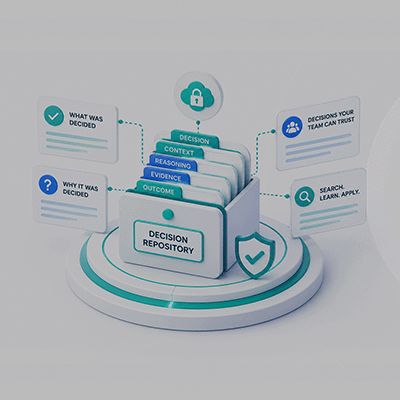
Reasoning is the bridge between knowing and deciding. Step 1 tells you what is changing. Step 2 tells you what it means and what to do. Step 3 , Decision as Object , captures the output of that reasoning as a persistent record, so the logic, the assumptions, and the trade-offs that went into the decision survive the meeting room and can be interrogated later.
↑ Learning from Step 5 feeds back into how reasoning is structured in Step 2 , the models get better calibrated with each cycle.
There is a compounding loop worth naming. Step 5 , Learn & Compound , identifies which reasoning paths produced accurate forecasts and which missed. That learning feeds back into Step 2, improving how future forecasts are built and which variables are weighted. Reasoning that is connected to institutional learning gets sharper over time. Reasoning done in isolated analyst sprints stays flat.
How does AI-powered reasoning differ from a traditional analyst or BI tool?
A BI tool gives you pre-built views of your data , charts, dashboards, standard reports. It answers questions that were anticipated when the dashboard was designed. An analyst gives you the ability to answer novel questions , but on a timeline governed by their availability, the complexity of the data joins required, and the revision cycle between their output and what leadership actually needed. AI-powered reasoning, as DecisionX implements it, combines the flexibility of an analyst (any question, in plain language) with the speed of a tool (minutes, not days), the depth of causal understanding (drivers and trade-offs, not just correlations), and a full explainability trail so the team understands the answer rather than just receiving it.
About this series
The Decision Lifecycle Feature Series maps the five steps that connect a strategic signal to institutional learning. Developed by Ranjan Kumar at DecisionX.
Step 1 , Signals & Blindspot Monitoring · Step 2 , Reasoning (this article) · Step 3 , Decision as Object · Step 4 , Track · Step 5 , Learn & Compound
Companion reading: the Decision Made ≠ Decision Done industry series , where the post-decision gap costs CPG, Manufacturing, Pharma, India D2C.


Ranjan Kumar is the Founder and CEO of DecisionX AI, the world’s first self-learning, context-aware Decision Intelligence platform that enables enterprises to make smarter, faster business decisions through agentic AI. A serial entrepreneur and three-time founder with over 17 years of experience, Ranjan previously built Entropik, the world’s first Emotion AI platform with 17 global patent claims. An IIT Kharagpur alumnus, he is widely recognized as a thought leader in enterprise AI, Ontology Engineering, decision reasoning, and AI-driven business transformation.