Track, Learn & Compound: The Post-Decision System That Closes the Loop - Steps 4 & 5

Ranjan Kumar

June 16, 2026
Most organizations are good at measuring what went wrong. Very few are good at understanding why , and almost none are good at making sure the same thing does not go wrong the same way next time. That is the gap Steps 4 and 5 close. Track watches whether the conditions a decision depended on are still true. Learn & Compound turns what was found into institutional knowledge , so the next team, the next quarter, the next cycle does not start from scratch.
The first three steps build toward a decision: surface signals, run the reasoning, capture the commitment. Steps 4 and 5 are what happens after. They are treated here as one system , because they are. Tracking without learning is just variance reporting. Learning without tracking has nothing real to learn from. Together they close the loop and make the whole lifecycle compound.
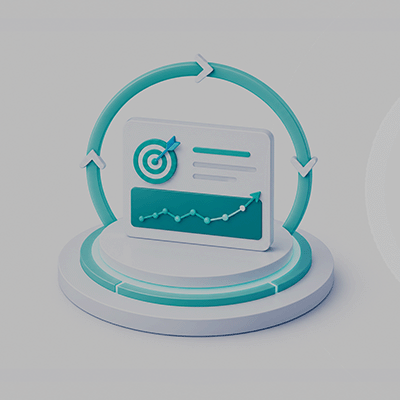
Step 4 asks: are the conditions the plan was built on still true? Step 5 asks: what did we learn from watching them, and how do we use that to make the next decision smarter? Together, they turn a one-time commitment into a building block of institutional knowledge.
Every organization tracks execution against plan. Revenue vs. target. CAC vs. benchmark. Margin vs. model. These numbers are necessary. But they only tell you the score , how far off you were. They do not tell you which underlying condition moved, when it moved, or what to fix so the next plan does not make the same mistake.
Tracking against assumptions answers a different question: are the specific conditions the plan depended on still true? It is the difference between knowing you lost and knowing why.
Compares actual results to the numbers in the approved plan , revenue, margin, CAC, retention. Tells you how large the gap is.
Does not tell you which assumption that produced those numbers was wrong.
Monitors whether the conditions the plan was built on are still true , the market growth rate, the churn assumption, the competitive position, the pricing elasticity.
Tells you which assumption failed, by how much, and what it implies for the next cycle.
Bain & Company found that executives estimate they lose 40% of a strategy's potential value not to bad planning but to execution breakdowns.[1] Most of those breakdowns are not execution failures , they are assumption failures that got labeled as execution failures because nobody was watching the assumption. The team was pushed to execute harder on a plan whose foundations had already shifted. Harvard Business Review puts the broader number at 67% of well-formulated strategies failing in execution.[2] Fix the execution, or fix the assumption tracking? The answer changes completely depending on which is actually the cause.
Good tracking in the Decision Lifecycle starts with the Reasoning Object from Step 3. Every major decision has two to four named assumptions recorded at the moment of commitment. Step 4 watches those assumptions , not as an annual review, but as a continuous background process that surfaces drift before it becomes a crisis.
Definition , Step 4: Track
Track is the post-decision process of monitoring whether the assumptions a decision rested on are still holding , continuously, not just at quarterly reviews , and surfacing drift early enough that course correction is still available.
Defined as Step 4 of the Decision Lifecycle by Ranjan Kumar, Founder of DecisionX, Track is distinct from variance reporting (which measures outcomes against targets) and from performance dashboards (which display current metric states). Track monitors the specific conditions named in the Reasoning Object , the assumptions the commitment was built on , and produces an assumption status record: which are holding, which are drifting, which have been breached, and what each status implies for the decision's continued validity.
Here is what assumption tracking looks like in practice. A company has made a significant channel investment decision. The Reasoning Object captures three assumptions. Step 4 watches each one:
The power of this view is not that it tells you something went wrong , it is that it tells you which specific thing went wrong, at the level of the original reasoning, before the P&L has caught up. In this example, the team does not need to wait for the quarterly revenue report to know that the channel investment needs to be revisited. The assumption that justified the investment has already been breached.
Every major commitment is built on a small number of assumptions about how the world will behave while the plan plays out. Assumption monitoring watches those specific conditions , continuously, against live data , and reports their status alongside the standard plan metrics. This is a different question from "are we on track?" It is "are the conditions that justified the plan still true?"
Assumptions do not usually snap from valid to invalid overnight. They drift. A retention assumption that was solid at the time of the commitment may be weakening gradually , showing early signals in cohort behavior before it shows up in aggregate churn. Drift detection watches the direction of travel on each assumption, not just the current state, and surfaces early-stage movement before any threshold is crossed.
This is the difference between catching a problem at month two (when four options are available) and catching it at month six (when the only option left is explaining the miss).
Not every drift requires a decision change. Some assumptions can soften without invalidating the original commitment. The revisit trigger , captured in the Reasoning Object at the time of the decision , defines the specific threshold at which the assumption has moved enough to warrant a formal re-examination of the decision itself. When that threshold is crossed, the system escalates: this is not a performance problem to manage, it is a decision that needs to be revisited with the original reasoning on the table.
Tracking tells you what happened to the assumptions. Learning is what you do with that information , specifically, converting it into the inputs for the next decision so that the same assumption failure does not repeat in the next cycle.
Most organizations do a version of this informally. Post-mortems happen. Retrospectives occur. Lessons-learned sessions are scheduled. The problem is that the learning is almost never connected back to the specific assumption that was wrong , because that assumption was never formally tracked. The post-mortem measures the gap to plan and attributes the miss to execution. The assumption that actually drove the miss , an overly optimistic retention estimate, a market sizing error, a competitive response that was not stress-tested , goes unnamed. The next business case starts with the same structural blind spot.
Definition , Step 5: Learn & Compound
Learn & Compound is the post-decision process of extracting specific, actionable learning from tracked assumption outcomes and converting it into the reasoning inputs for the next decision cycle , so that each cycle is structurally smarter than the last.
Defined as Step 5 of the Decision Lifecycle by Ranjan Kumar, Founder of DecisionX, Learn & Compound is distinct from a post-mortem (which reviews what happened), from a lessons-learned session (which captures general takeaways), and from performance reviews (which evaluate outcomes against targets). It is specifically concerned with assumption-level learning: which assumption was wrong, by how much, in which direction, and what that implies for how the same type of assumption should be calibrated in future decisions of the same type. Its output , a learning artifact attached to the Reasoning Object , feeds back into Steps 1 and 2, improving how signals are read and how reasoning is structured the next time a similar decision arrives.
A conventional post-mortem asks: "why did we miss the target?" RCA against assumptions asks a more precise question: "which of the specific assumptions recorded in the Reasoning Object was wrong, by how much, and why?" These are different questions, and they produce different answers , answers that are actually useful for the next cycle rather than just explanatory for the current one.
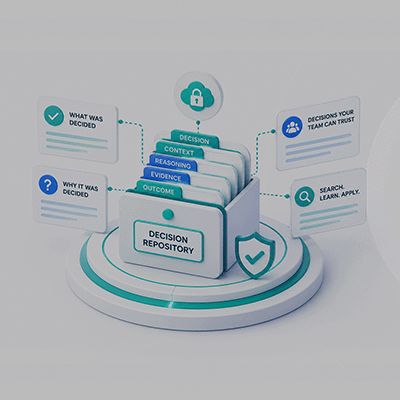
Learning becomes compounding when it is connected forward , when the insight from what went wrong in this decision informs how the same type of assumption is made in the next one. Cross-cycle learning is the mechanism that does this: it identifies the specific assumption that failed, attaches the learning artifact to the Decision Repository, and surfaces it automatically when a future decision involves the same assumption type in a similar context.
The ultimate output of Steps 4 and 5 running together is an organization where decision-making gets smarter independently of the people doing it. New leaders inherit not just what was decided before but the calibrated assumptions, the identified failure modes, and the extracted learning from every cycle that preceded them. They do not start from zero. They start from what the organization already knows.
This is the compounding the lifecycle is named for. Not that individual decisions get better , though they do. It is that the organization's ability to make decisions improves structurally, cycle by cycle, in a way that survives leadership changes, team turnover, and time.
Here is a point that is easy to miss: institutional knowledge is not only built from big strategic bets. It is built from every level of decision , the quarterly operating calls, the campaign allocations, the pricing adjustments, the vendor negotiations. All of them carry assumptions. All of them produce learning. And all of that learning, if captured and connected, becomes reusable intelligence the next time a similar situation arrives.
Most organizations treat these three levels of decision completely separately. Strategy team owns the strategic layer. Operations reviews the operational layer in QBRs. Tactical decisions live and die inside individual team meetings. None of it connects. The operational team that learned exactly when a fulfillment partner starts to slip on SLAs never tells the strategy team that the expansion plan depends on that same partner. The sales team that found the exact trigger phrase that closes enterprise deals in Q4 never tells the next cohort of reps. The learning exists , it just does not compound.
What market assumptions held when we expanded into the Southeast? Which adjacency bets succeeded and what did the successful ones have in common? What competitive positioning assumptions have aged well and which have consistently been wrong?
At what pipeline coverage ratio does the sales team consistently hit quota? How long does it actually take to ramp a new AE to full productivity? When does a fulfillment partner's SLA start slipping under volume pressure?
Which channels produced customers who actually retained? Which discount thresholds drove trial without training customers to wait for promotions? Which product features drove expansion revenue vs. just satisfaction scores?
DecisionX captures learning across all three levels , not just the strategic ones. Every Reasoning Object, whether it belongs to a board-level portfolio decision or a quarterly campaign allocation, gets its assumptions tracked, its drift detected, and its learning extracted in the same way. The result is an institutional knowledge base that reflects how the business actually operates , not just the headline decisions, but the operational and tactical patterns that determine whether strategic bets pay off.
A new manager who joins the growth team does not need to re-learn that Q4 promotions above 20% churn out. A new VP of Sales does not need to discover through a bad quarter that enterprise AE ramp takes 140 days. A new Head of Strategy does not need to repeat the market entry mistake the company made in 2023. The learning is in the system. It is available. It is reusable.
Steps 4 and 5 do not just close the current decision cycle. They feed the next one. Here is how the full loop runs:
Most organizations try to improve post-decision tracking through process discipline , a template, a quarterly review, someone's responsibility to fill in a slide. It works until the quarter gets busy. The slides become status updates. The learning never feeds forward. The next plan repeats the same structural errors with slightly updated numbers.
DecisionX runs this system continuously , not quarterly, not on request, not depending on anyone's discipline to maintain it.
Tracking is automatic. The assumptions in every Reasoning Object are monitored against live data , CRM, financial systems, operational metrics, external signals. Status is updated in real time. Drift is flagged by direction of travel, not just threshold breach. The revisit trigger fires when the specific condition recorded at the time of the decision is crossed , not a generic alert, but the exact signal the team said would matter.
Learning is structured, not narrative. When an assumption is breached, DecisionX runs root cause analysis specifically at the assumption level , tracing the causal chain to identify what drove the shift, how far it deviated, and in which direction. The output is a structured learning artifact attached to the Reasoning Object: not a memo, not a slide, but a calibrated record that the system can surface the next time a similar decision arrives.
Compounding happens across all three levels. Strategic decisions, operational plans, and tactical experiments all run through the same system. A campaign assumption that proved wrong gets captured. A hiring ramp assumption that consistently missed gets corrected. A market entry pattern that worked three times gets codified. All of it lands in the same institutional knowledge base , and all of it is surfaced automatically when the next relevant decision arrives, regardless of what level it sits at.
A B2B software company misses its Q3 revenue target by 22%. Here is how that miss gets diagnosed and responded to , with and without the post-decision system in place.
The QBR deck shows the miss. The diagnosis: pipeline conversion underperformed, mid-market segment was weaker than expected, one enterprise deal slipped. Action items: pipeline review cadence increased, mid-market quota adjusted, deal review process tightened. The Q4 plan is built on the same structural assumptions as Q3 , the enterprise deal size model, the mid-market CAC payback estimate, the competitive positioning assumptions , because none of them were being tracked and none of them were identified as the actual driver of the miss. Q4 underperforms for the same reasons.
Assumption tracking surfaces the cause six weeks before the QBR. The mid-market CAC payback assumption , recorded in the Reasoning Object as "under 9 months at current conversion rates" , has been running at 13 months since a competitor dropped pricing in July. The enterprise deal size assumption is holding. The root cause analysis confirms that 78% of the miss traces to the CAC payback shift, not to pipeline volume or conversion. The Q4 plan is built with a revised CAC assumption, a competitive response modeled into the pricing architecture, and a specific monitoring trigger for the enterprise segment. The Q4 team is not working harder on the same broken plan , they are executing a plan built on what was actually learned from Q3.
Steps 4 and 5 are where the Decision Lifecycle earns the word "lifecycle." Without them, the system is a one-way pipeline: signals go in, decisions come out, nothing feeds back. With them, every decision becomes a source of learning that shapes the next one , and the organization accumulates institutional intelligence that compounds over time.
↑ Step 5 learning feeds back into Step 1 signals and Step 2 reasoning , the feedback loop that makes the system compound rather than just process.
An organization running all five steps does not just make better individual decisions. It builds a decision-making capability that improves with every cycle , because the feedback loop is intact, the assumption failures are named rather than misdiagnosed, and the learning is available to whoever makes the next relevant decision, regardless of whether they were in the room for the last one.
About this series
The Decision Lifecycle Feature Series , the five steps that connect a strategic signal to institutional learning. Developed by Ranjan Kumar at DecisionX.
Step 1 , Signals & Blindspot Monitoring · Step 2 , Reasoning · Step 3 , Decision as Object · Steps 4 & 5 , Track, Learn & Compound (this article)
Companion reading: the Decision Made ≠ Decision Done industry series , where the post-decision gap costs CPG, Manufacturing, Pharma, India D2C.

Ranjan Kumar is the Founder and CEO of DecisionX AI, the world’s first self-learning, context-aware Decision Intelligence platform that enables enterprises to make smarter, faster business decisions through agentic AI. A serial entrepreneur and three-time founder with over 17 years of experience, Ranjan previously built Entropik, the world’s first Emotion AI platform with 17 global patent claims. An IIT Kharagpur alumnus, he is widely recognized as a thought leader in enterprise AI, Ontology Engineering, decision reasoning, and AI-driven business transformation.